Loc. Vertine 1, 53013 Gaiole in Chianti (SI), Italy
extra-virgin olive oil · food contact · single use
It is happening more and more, and it is not a whim: the declaration has been mandatory since 12 August 2026 and without it, goods do not ship. We write to the glassworks, the closure maker and the label printer, collect the evidence, compile the technical file and the declaration. You sign and ship.
Five questions, 60 seconds. We tell you whether you are obligated and what is needed. Free, no sign-up.
Want to click around? Open the demo, no sign-up →

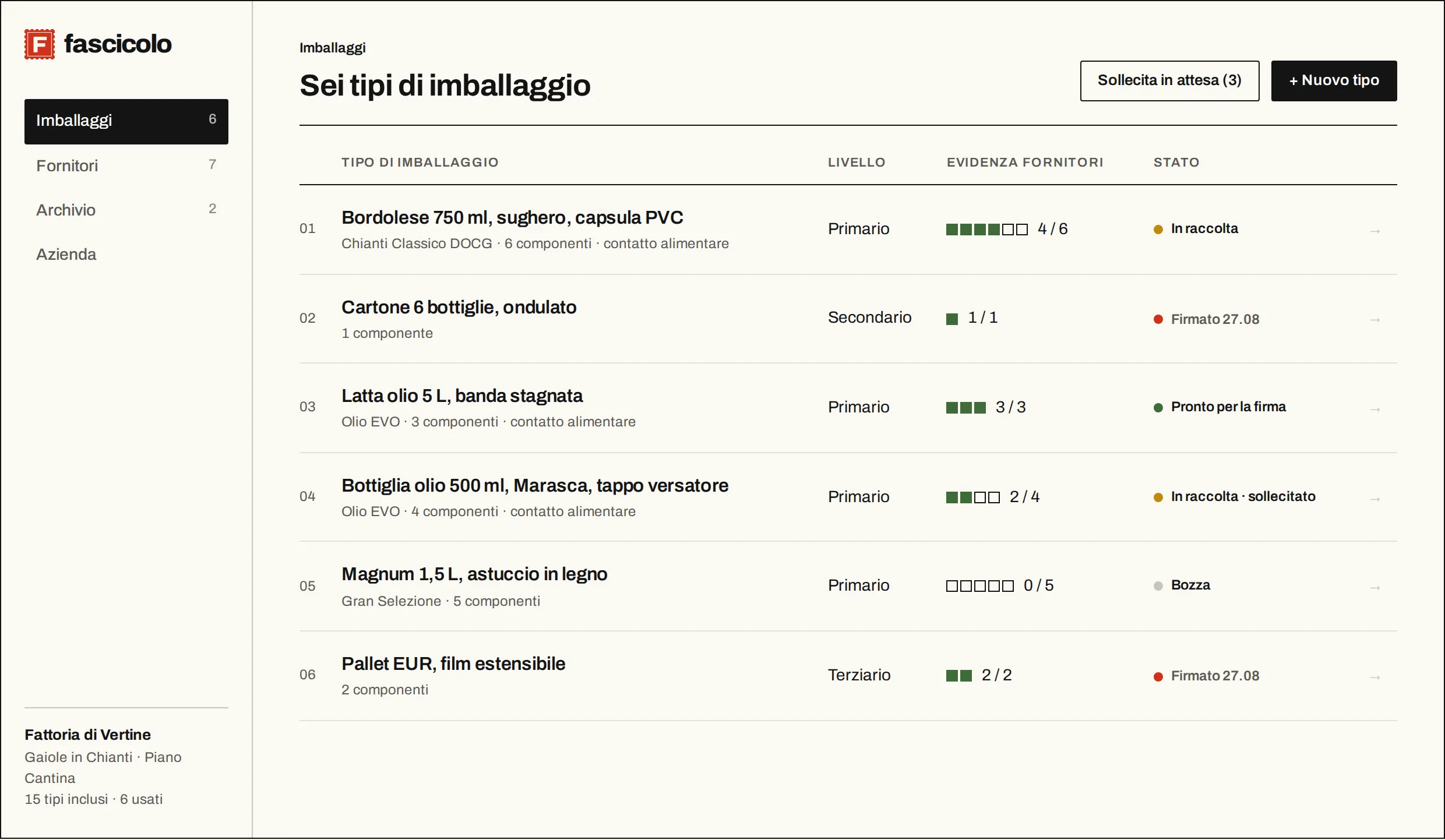
Every packaging type on one line. A green square for each supplier who has answered. What's missing is obvious at a glance.

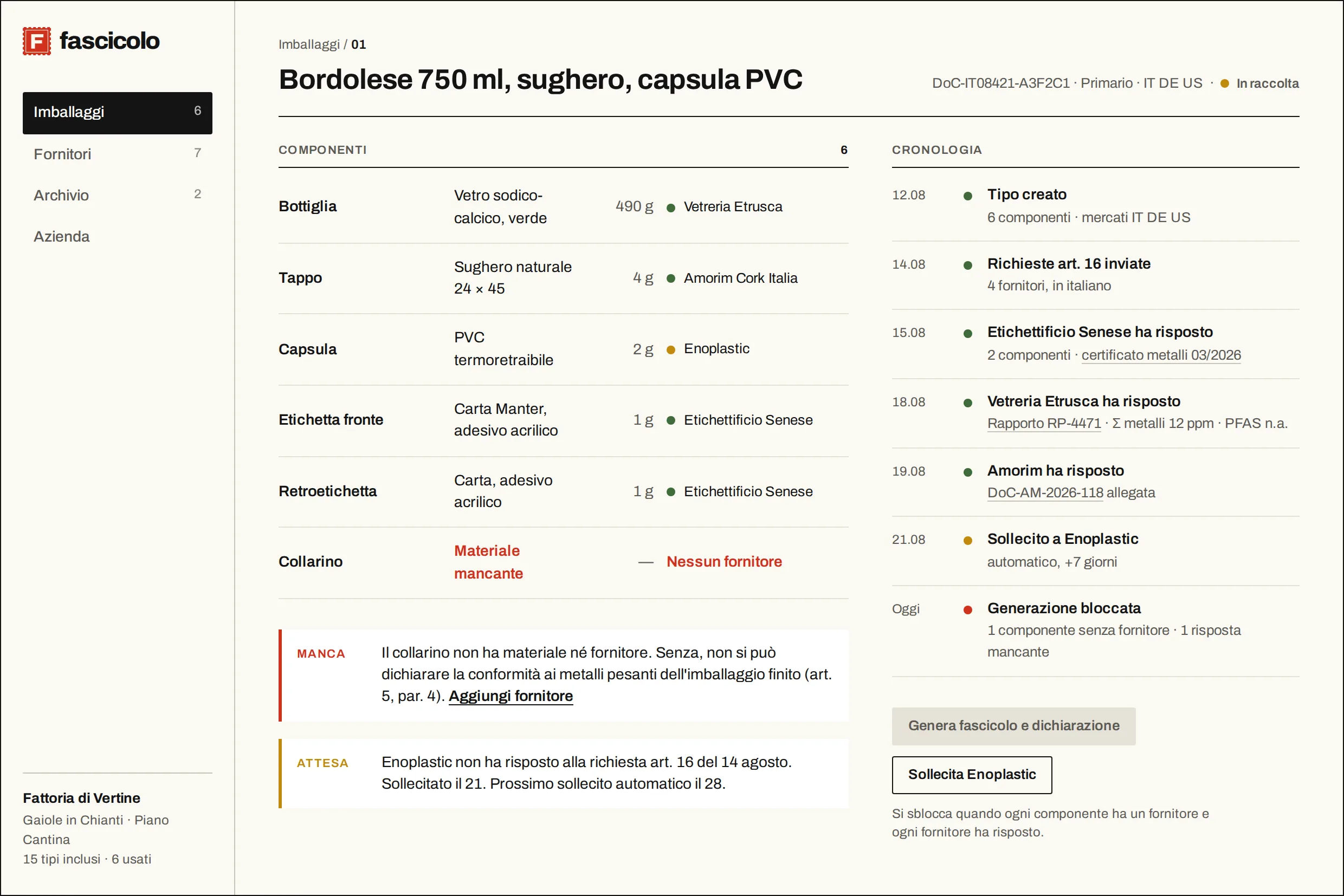
Components, suppliers, evidence received, a timeline of every request and reminder. If something's missing, we tell you in one sentence.
The ten items of Annex VIII, each conformity line with its evidence reference. Print, sign, archived.
Add each type and its components: bottle, closure, capsule, labels, carton. Link each to a supplier. Pick your markets.
An Article 16 request in their language with a secure link. They answer in a form; we chase them.
We assemble Annex VII, check it against the regulation's rules and produce Annex VIII in every market language, ready to sign.
Since 12 August 2026 the substance limits apply too: lead, cadmium, mercury and hexavalent chromium together no higher than 100 mg/kg (Art. 5(4)) and, for food-contact packaging, the PFAS limits (Art. 5(5)). Knowing it is not enough: the evidence has to sit in the technical documentation, and your suppliers hold it.
Bottle, closure, capsule, seals: anything touching the wine is in scope. Synthetic closures and capsules are where suppliers answer slowest.
Tinplate tin, internal coating, pourer cap: the internal coating statement is the document that matters, and tinplate producers already hold it.
Twist-off caps with a seal: the critical component, and almost no supplier sends it unprompted. You have to ask, citing the article.
We send the supplier requests, in their language, citing Art. 16 which obliges them to answer. And we chase until they do.
Since December 2023 every wine placed on the EU market must carry an ingredient list and a nutrition declaration. The law allows these to move to an e-label: a QR opening a page with the ingredient list and the nutrition table. The energy value and allergens stay printed on the physical label: the QR lightens the bottle, it doesn't replace it.
It's the data sheet: ingredients in descending order of ingoing weight, additives by functional category plus name or E number, energy calculated with the official coefficients from alcohol, sugars, glycerol and acids. You already have the figures in your certificate of analysis: we turn them into a correct declaration.
No advertising, no shop links, no cookies or tracking: the regulation forbids it and our pages don't do it. Only the required information, readable on a phone, in Italian and in your sales languages.
The QR printed on a bottle has to work for the whole life of the product. The pages are ours and stay live; change your label printer and nothing changes. With Custody, the update for each vintage is included.
A €49 template doesn't email your glassworks. A €2,000 consultant doesn't scale to three labels.
For scale: €390 is less than one export order held at customs, less than a pallet of glass.
Prices exclude VAT. Laboratory testing, if a supplier can't evidence conformity, is quoted separately and beforehand.
My name is Tom Riby. I'm English, I've lived in Chianti for twelve years and I work with local producers. Fascicolo is a new service, started in 2026: not a firm with twenty staff, one person with software tooling and a partner engineer for the machinery side. I say so upfront because it's what I would want to know before handing anyone a legal obligation.
The inventory is free and the demo is public: you pay only after seeing your own register. Full refund if you change your mind before the supplier requests go out. You sign the declaration, as the regulation requires: we prepare the documentation behind it.
Selling into the EU from: UK · US · Switzerland · Australia · Canada
Guides in English →
It covers their component and their liability. If the product carries your brand, the declaration for the finished packaging is yours to sign. Supplier declarations are evidence in your file, not a substitute.
You are a third-country manufacturer: you need the file, a signed declaration and an EU-established authorised representative holding the documentation. Your EU importer must verify it and keep a copy.
The standard route is Module A (internal control). Heavy-metal and PFAS evidence normally comes from your material producers. If it's missing, we tell you what a test costs first.
Packaging without a declaration may not be placed on the market. Penalties are national and being set; the Commission has told authorities to warn first. The immediate risk is commercial: customers and importers asking for documentation.
No. Fascicolo collects data and prepares documents. Your legal representative signs and remains responsible.
No. The QR and the address stay the same; what changes is the page content. If a new vintage has different ingredients or nutrition values we update the page, and the QR already printed keeps pointing to the correct label. With Custody, the update for each vintage is included.
Nothing commercial: no advertising, offers, shop links or promotional content. The regulation also forbids collecting or tracking data about whoever opens the QR. Our e-label pages carry only the mandatory information, with no cookies and no analytics.
Nothing: the addresses stay live because they are ours, not a label printer's or an agency's. A page is never switched off; if a product leaves the market the page stays and says so. A QR printed on a bottle sold five years ago must still work, and it does.